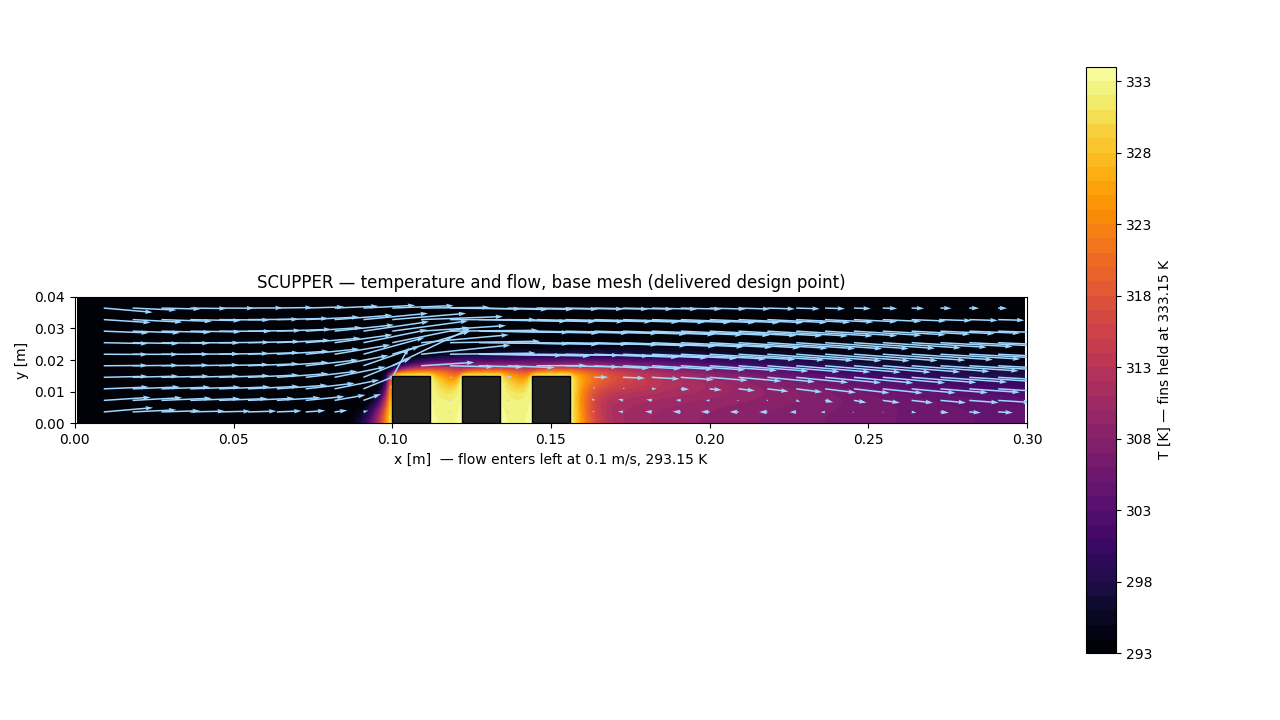
SCUPPER — a thermal study whose pretty pictures are not the evidence
Receipt-derived 3D inspection
Thermal duct study
Compare the caught state with the accepted delivery. The model is an inspection aid; the gallery and receipt remain the evidence.
The receipt
DIY: OpenFOAM £0 software.
SeaOtter: accepted checks · included rework · usable rights.
The checks refused the first delivery, the work was fixed, then £722.25 was released.
£722.25settled
- cleared
- decided
- on a machine
- badge status
- Historical receipt dated 5 Aug · current typed replay unavailable
- team paid
- £528.20
The exact record
The machine's own identifiers, kept so anyone can re-check this page against the recorded run. Nothing above is missing from here.
- settled
- £722.25
- cleared
- 5 Aug 2026
- badge status
- Historical receipt dated 5 Aug · current typed replay unavailable
- team paid
- £528.20
- refused round
- Rev A refused — 7 physics bars failed · Revision A stopped at 60 iterations; the sealed bars refused it on seven counts. · 0.9943 · Ran to 3,000 iterations — energy closure 0.14%, mesh changes ≤0.78%, rerun bitwise identical.
- receipt
- 9b4e7fcb26396908
- evidence
- Banked evidence record
How the money moved
- saidFive buyer-quoted criteria sealed across three priced leaves, with the numeric bars measured by a capability probe and sealed before the first delivery run.—
- checkedThe unchanged validator refused the truncated red run on seven sealed bars at once: residuals above floor, energy closure 99% open, no warmed exit air.—
How the money moved
- said
- checked
The catch
Rev A refused — 7 physics bars failed
The exact record
The machine's own identifiers, kept so anyone can re-check this page against the recorded run. Nothing above is missing from here.
Revision A stopped at 60 iterations; the sealed bars refused it on seven counts.
Then: Ran to 3,000 iterations — energy closure 0.14%, mesh changes ≤0.78%, rerun bitwise identical.
A job like yours
Get a fixed price from your brief. Pay when its checks pass.
Price a job like thisThe machine — every check, run and refusal, on the recordopen ▾close ▴
The commission
What was asked
The buyer designs compact electronics enclosures and is done approving thermal studies on the strength of a pretty contour plot. The case must regenerate byte for byte, the run must prove itself against sealed numeric bars, and the pictures must survive an independent physical-credibility review that is itself tested with planted fakes.
Three meshes, one answer, to the byte
The accepted run
Coarse, base and fine meshes — 5,430 to 27,460 cells of exactly orthogonal hexes — agree on the exit-air temperature rise within 0.78% and on the pressure drop within 0.25%. The fin-side heat is recomputed from the raw mesh and field bytes, never read off a solver log, and closes against the enthalpy carried out of the duct to 0.14%. Running the base case again reproduces every byte of the solved field.
- energy closure
- 0.14%
- mesh agreement
- ≤0.78%
- same-input rerun
- 0 bytes
- doctored fields caught
- 4 / 4
The design point is from the same record: at the first-probed 0.30 m/s the fin wake is unsteady and the steady solver plateaus, so the commission bound the 0.10 m/s steady point instead of pretending convergence.
Red first — the bars earn their keep
The red run
The same engine was stopped at 60 iterations: a field that renders beautifully and means nothing. The unchanged validator refused it on seven sealed bars at once — residuals above floor, energy closure 99% open, no warmed exit air — and the refusal is banked beside the delivery.
Energy closure 99% open; the exit air never warmed.
Same engine, same sealed bars; only the run length changed.
revA: energy closure 0.9943 > 0.02 · deltaT 0.000 K outside [3.0, 4.2] · residuals above floor → exit 1

coarse/base/fine/rerun: closure 0.0014 · ΔT 3.5699 K · fin heat 17.27 W/m · rerun delta 0 → exit 0
bars sha256 af2339204070ce869f2f1148… sealed before the first delivery run
Four doctored fields, four catches
The doctored-field test
Four fakes were derived from the commission's own solution — the wake advected upstream against the arrows, the hot region detached from the fins, the temperatures inverted, the flow drawn straight through solid metal — all drawn in exactly the delivered style. The pixel battery passes every one of them; the credibility review caught every one, and passed the four undoctored renders with cited image evidence.
render-1..4.pngFour delivered field depictions — drawn from the solved cells.
passimitation-1..4.pngFour doctored fields derived from the same solution: upstream wake, detached plume, inverted source, flow through solid metal.
caughtThe review cut both ways: it first refused our own depictions — coarse-mesh arrow sampling that read as vertical flow, and a speed-only render that could not answer a thermal brief — and in one round it waved through two subtler fakes. That is the boundary of what it can catch. The delivered catches are of unmistakable violations, not of every conceivable forgery.
gpt-5.6-terra · fixture set 2026-08-04.2 · flaw recall 1 · sycophancy 0 · banked judged-review record
One contract, three priced sub-contracts
The split
- parametric case build + byte-exact regeneration£282.50
- field depictions + judged credibility red-team£157.25
- solver runs + sealed physics bars£282.50
The bytes, and what the checks made of them
The evidence
The buyer's balance was funded through the production Stripe webhook handler, held against the sealed root, and drawn leaf by leaf only as each banked acceptance receipt verified. Every ledger entry sums to zero.
- root
- £722.25
- worker take
- £528.20
- ledger
- zero-sum
pi_3U0ybGFFRbB25fA71TI0SJrX · Stripe TEST · livemode=false · settled 2026-08-05 · banked settlement record
What it can't catch
What this does not cover
This study proves steady laminar forced convection for one duct-and-fin geometry family at its sealed design point, computed by the OpenFOAM solver and closed to 0.14% — not turbulence, not conjugate solid conduction, not a licensed engineer's stamp, and not certification of the review against every conceivable doctored field.
Banked acceptance record · 5 Aug 2026